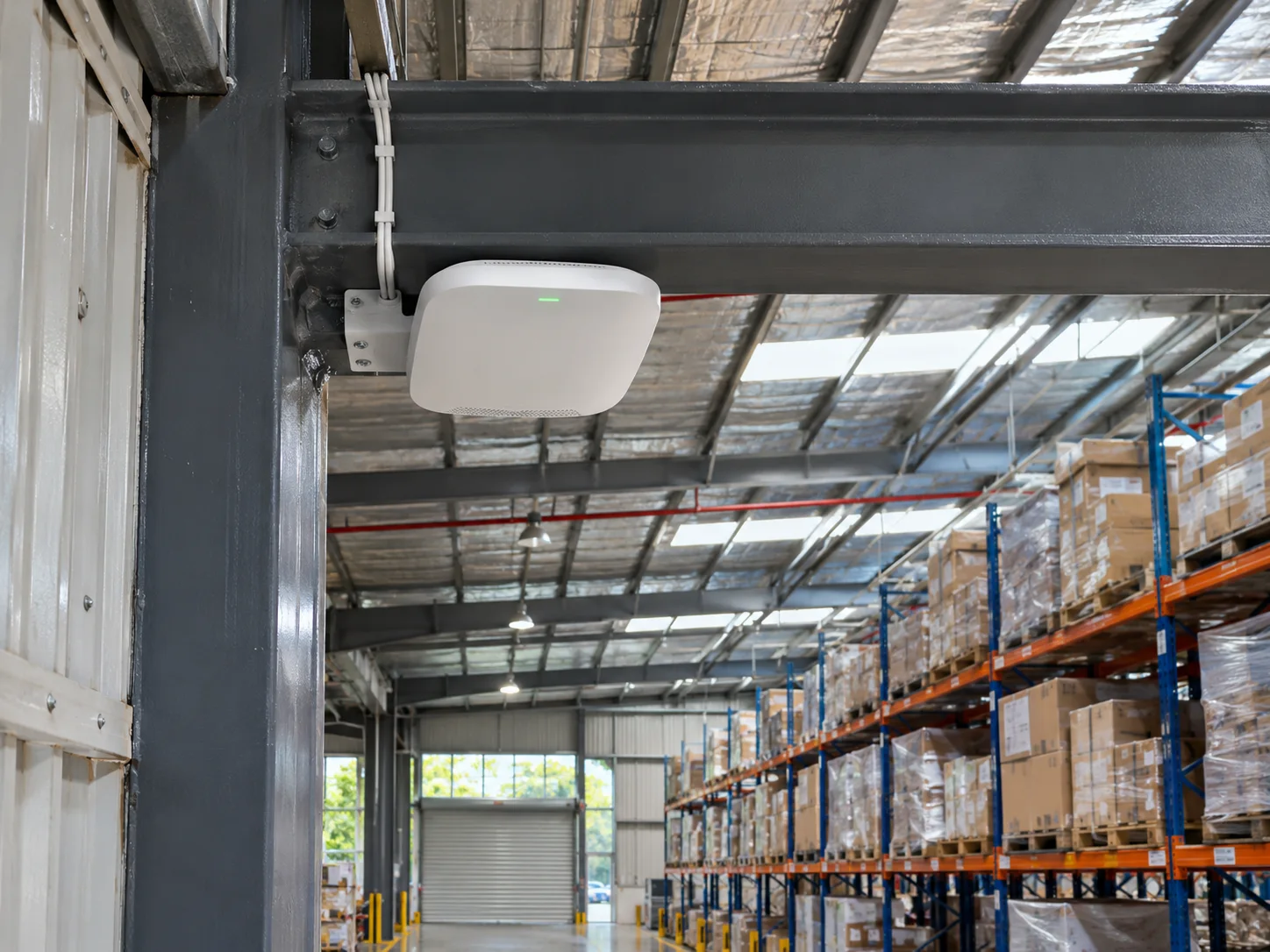
Case study 01 · Commercial Wi-Fi · Bordeaux
When the warehouse had coverage, but the scanners still stopped working
Diagnosing roaming failures across a busy distribution floor without interrupting daily dispatch.

The problem: signal bars did not tell the whole story
A distribution company on the outskirts of Bordeaux was preparing to expand its evening shift. On paper, its warehouse already had Wi-Fi: staff could see a signal on their handheld barcode scanners in most aisles, and office laptops connected without difficulty. In practice, pickers repeatedly lost their sessions when moving between storage zones. Some scans appeared several seconds late; others had to be repeated. The delays were small individually, but multiplied across hundreds of picks they made dispatch unpredictable and created avoidable rework at the packing benches.
The first temptation was to add access points wherever workers reported a weak signal. That approach risked increasing interference without solving the underlying issue. A wireless network can show strong received power and still perform poorly if neighbouring radios compete for airtime, channels overlap, clients cling to a distant access point, or the application depends on consistent roaming. The warehouse also contained tall metal racks, moving stock and high shelving, all of which changed how radio energy travelled. Measurements taken in an empty building would not necessarily describe conditions during a normal shift.
Investigation: measure the network in its real environment
The assessment began with a walk-through alongside the operations supervisor. The team mapped the scanner routes, dead-stop locations, loading doors and the points where failures were most frequently reported. Rather than relying on a single signal-strength reading, the survey recorded signal quality, channel utilisation, neighbouring networks and hand-off behaviour while walking representative routes with a test client. The team repeated key measurements during working hours, when forklifts, people and stocked racks changed the environment.
That process revealed several separate contributors. Two access points shared a channel with nearby equipment and were competing for airtime. A third unit was mounted at one end of an aisle, leaving a poor transition zone behind a metal partition. Several scanners held onto their original connection longer than expected, even after a closer radio became available. The result was not one dramatic dead spot but a series of marginal hand-offs. Every individual condition looked survivable; in combination they caused timeouts for an application that expected a stable connection.
The team also reviewed the physical installation. One access point was partially shielded by a steel beam, while another was mounted at a height and orientation that did not match the intended coverage pattern. The existing cabling was checked before any new radio was proposed, because a weak or intermittent wired uplink can look like a wireless fault from the user’s point of view.
The resolution: improve placement, channel design and roaming
The corrective plan prioritised predictability over raw access-point count. The affected access point was repositioned to provide a cleaner line of coverage along the aisle transition. Radio channels and power levels were adjusted to reduce unnecessary overlap and to make neighbouring cells easier for client devices to distinguish. The team retained the existing network identity so the scanners did not require a disruptive reconfiguration, then tested the client roaming settings against the actual device models in use.
Before implementation, the operations lead selected a quiet maintenance window and identified a short validation route that could be walked without blocking dispatch. After each adjustment, technicians repeated the same route and recorded where devices changed access points, whether the application remained responsive and whether the wired link showed errors. This made it possible to separate an improvement in radio coverage from a genuine improvement in application behaviour. The company also received a simple floor plan marking access-point locations, the checked routes and the settings that should be documented before future changes.
The key operational decision was not to promise that every handheld would behave identically. Wireless clients vary, and application timeouts depend on both the network and the software. Instead, the acceptance check focused on the named scanners, their normal movement and the business-critical workflow. That gave the warehouse a repeatable baseline and a way to diagnose future changes, such as a new metal storage bay or a different scanner model.
What changed and what other sites can learn
After the work, the supervisor reported fewer interrupted picking sessions on the routes included in the validation walk. The team could now distinguish a coverage concern from a client-roaming or application issue and had a documented layout to support future maintenance. Those observations are specific to the illustrative scenario; any live project should measure its own baseline and agree success criteria before work begins.
The warehouse also established a lightweight follow-up routine. The supervisor kept the test route available for future device changes, and the facilities contact recorded the access-point model and installation location. If a new rack layout is introduced, the team can compare conditions against the original measurements instead of assuming the network has spontaneously degraded. If a scanner is replaced, staff can check whether its roaming behaviour differs from the known devices. This turns troubleshooting from anecdotal reporting into a comparison against a useful, site-specific reference.
The broader lesson is that warehouse Wi-Fi should be designed around movement and tasks, not just static coverage. Start by recording where users travel and what devices they carry. Survey the premises while it is operating, inspect both the radio and wired sides, and test hand-offs with the actual client equipment. Adding hardware can be right, but only after understanding whether the limiting factor is coverage, interference, roaming behaviour, mounting position or the uplink. A measured, documented adjustment is easier to maintain than a growing collection of access points installed in response to individual complaints.
Keeping performance dependable as the warehouse changes
A network that works on installation day still needs a sensible change process. In this case, the operations supervisor added a short connectivity check to the warehouse’s seasonal layout review. Before a new aisle or high-density storage area is brought into use, the team notes whether it changes the established walking route, blocks a radio line of sight or places equipment close to an access point. If the layout changes materially, the same scanner route can be walked again and compared with the baseline. This is a low-effort way to catch a developing issue before it becomes a shift-wide complaint.
The support notes also record the scanner models and application workflow used for acceptance. If a future device update changes roaming behaviour, technicians can tell whether a reported timeout began with the network, the endpoint or an application change. The notes are not a substitute for monitoring, but they help staff report useful evidence: the aisle, time, device and task affected, rather than simply saying that Wi-Fi is slow. That information makes a targeted investigation faster and reduces the risk of unnecessary configuration changes during a busy period.
For a warehouse planning similar work, include staff who use the scanners in the survey and acceptance walk. Their normal routes reveal turns, pauses and loading areas that a floor plan alone can miss. Schedule testing around a realistic operating condition, agree who can approve a brief maintenance window, and keep an up-to-date record of radio and cabling changes. These steps turn a one-off repair into a maintainable operational improvement.
Photo briefs
Illustrative AI-generated images based on each scenario; these are not verified client photographs.