Case study 02 · Fibre & structured cabling · Mérignac
A new fibre connection was not enough for a growing professional office
Turning an unreliable patchwork of broadband, switches and desk cabling into a documented network foundation.

The problem: fast internet at the entrance, slow work at the desks
A professional services office in Mérignac had recently upgraded its internet subscription. The provider’s equipment showed that the fibre connection was active, yet staff still experienced slow file transfers, frozen video calls and intermittent access to a shared document system. Complaints were strongest in two meeting rooms and at the far end of the office. The business initially suspected that the new fibre service had been provisioned incorrectly.
The premises had grown in stages. Desks had moved as the team expanded, small switches had been added under workstations, and patch leads of different lengths crossed a storage area. A few wall outlets were labelled, but the labels did not consistently match the patch panel. The provider’s router, an older switch and several informal extensions had accumulated in a cupboard. A fibre hand-off can deliver a capable service, but it does not automatically repair the local network that distributes connectivity around a building. The challenge was to identify where the slowdown occurred without replacing working equipment unnecessarily or disrupting a full day of client appointments.
Investigation: trace every link from fibre hand-off to user
The work began by establishing a simple inventory: internet hand-off, router, switches, patch panel, wall outlets and the users who depended on each area. The office manager described when the problems occurred and which services were most affected. Technicians then tested the incoming service at the network boundary, checked the active equipment and traced representative desk connections back through the building. This separated provider-side performance from local cabling, switching and Wi-Fi issues.
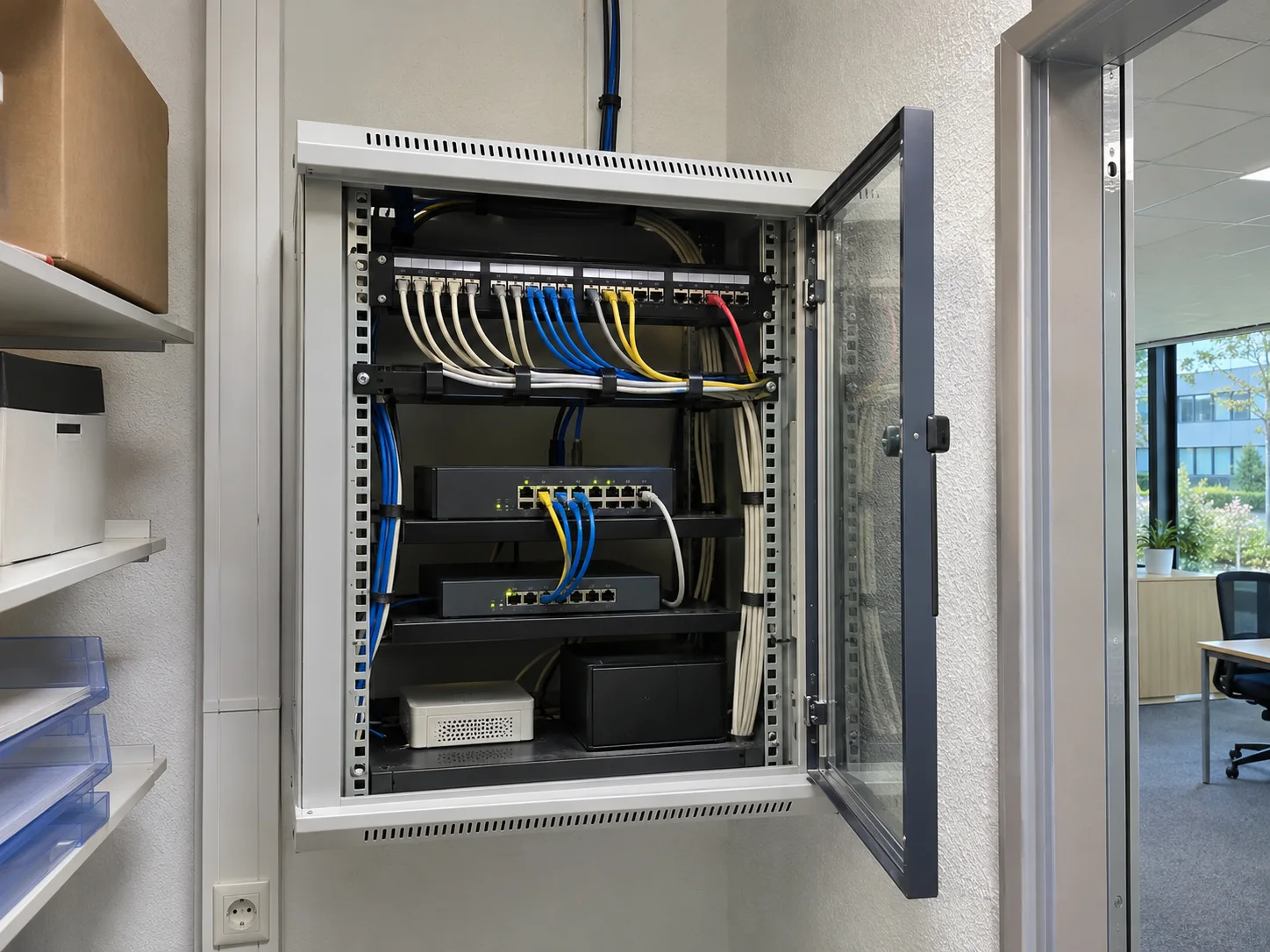
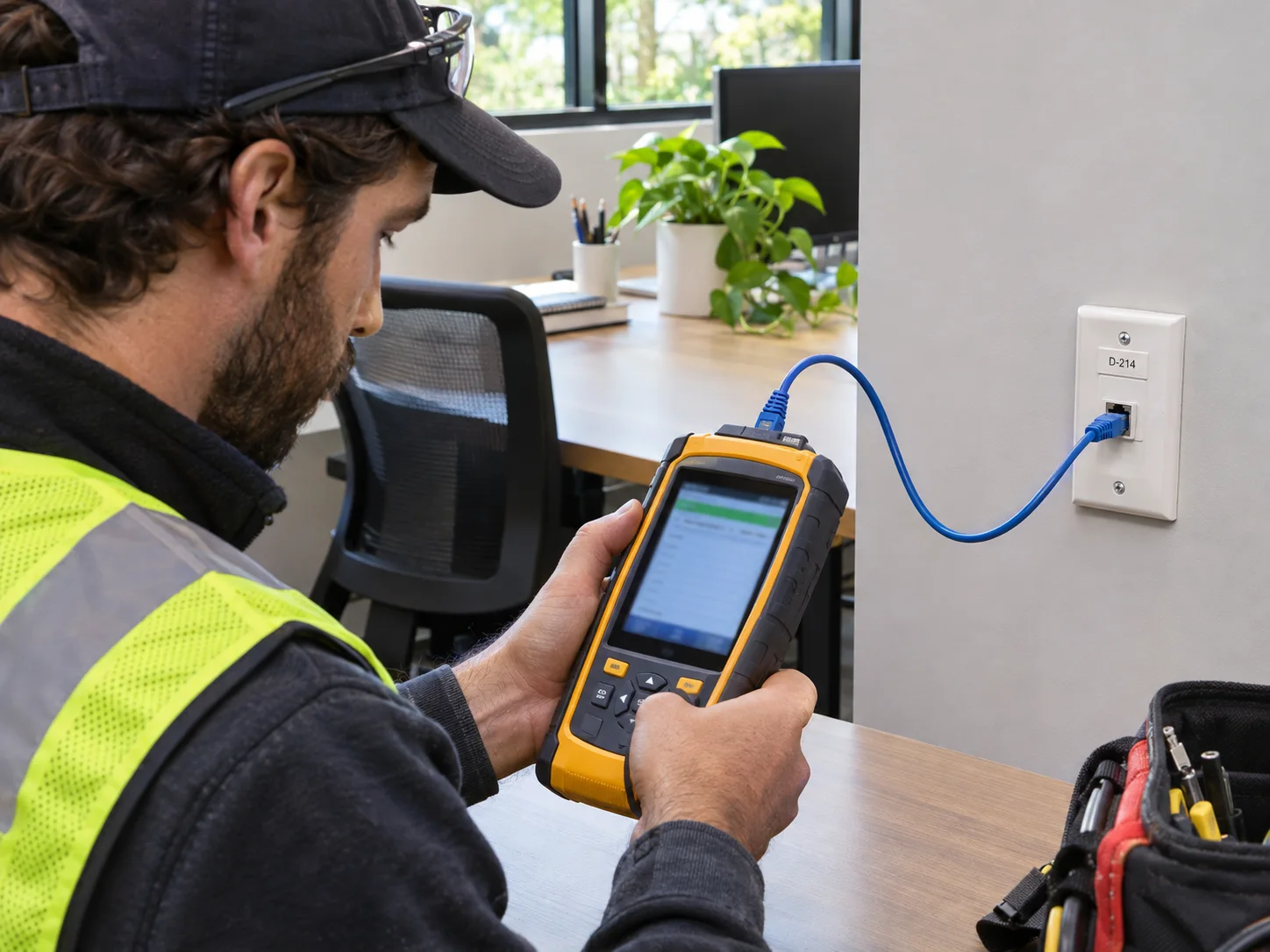
The tests showed that the fibre service was not the sole cause. A number of desk connections depended on a small unmanaged switch connected through a long daisy-chain. One link negotiated at a lower speed than expected, and the meeting-room access point shared a congested uplink. In the cabinet, patch leads were difficult to follow and several connections had no reliable destination label. The mixed arrangement made troubleshooting slow: when a user reported a problem, staff could not quickly determine which outlet, cable or switch port served that desk.
The team checked the condition and testability of existing fixed cabling before proposing replacement. It also considered the practical constraints: the office needed to remain available for calls, and the landlord required approval for any route through shared building areas. Rather than treating a network refresh as an excuse for a full rebuild, the scope focused on the affected links, clear labelling, cabinet organisation and a design that could accommodate a modest number of additional desks.
The resolution: create a traceable, maintainable distribution layer
The agreed work consolidated the office’s network distribution around a central, labelled patching point. Where existing cable routes were suitable, they were retained and tested; where a link could not support the required service reliably, a replacement route was planned and installed with the building constraints in mind. The ad hoc daisy-chain was removed from the business-critical path, and the meeting-room access point was connected through a known-good wired uplink. Patch-panel ports and corresponding wall outlets received matching labels.
Changes were sequenced to minimise downtime. Before moving a connection, the technician confirmed which employee or device depended on it. A small number of desks were moved at a time, and the office manager validated access to the shared system and video meetings after each group. Cable tests, link-speed checks and a practical service check were recorded. The final handover included an outlet schedule, a cabinet layout and notes identifying which equipment belonged to the internet provider versus the office network. That distinction matters when a future fault must be referred to the right support team.
The team also agreed a few operating rules with the office manager: avoid adding unmanaged switches without recording them, keep spare patch leads labelled, and make network changes in a planned window. These are modest process changes, but they prevent the hidden topology from growing back. The result was not simply a neater cabinet; it was a network whose important paths could be understood and tested.
Outcome and practical lessons
In the illustrative case, the office reported more consistent performance at the affected desks and fewer unexplained meeting-room interruptions after the cabling and switching changes. Staff gained a useful map of the connections, making it easier to isolate later faults. The outcome should not be read as a guaranteed speed improvement for every fibre installation: measured performance depends on the service plan, router, switches, endpoint devices, application and concurrent demand.
The documentation also made future growth easier to plan. When the office manager later considered adding desks, the outlet schedule showed which locations already had tested connections and where additional capacity might be needed. That avoided treating every move as an emergency and helped the business coordinate installation work with the landlord. A useful handover should be understandable to someone who was not present during installation: clear labels, a simple diagram and notes about equipment ownership are more valuable than an elaborate document nobody can maintain.
For other growing offices, the central lesson is to test the whole path. Check what arrives at the building, then follow a representative connection all the way to the device. A fast service can be undermined by a poor local link, an overloaded intermediate switch or a wireless access point attached through an unreliable route. Before purchasing faster broadband or replacing every cable, document the existing topology and identify the specific bottleneck. Correct labelling and a straightforward handover are part of the technical solution because they make the next change safer, faster and less dependent on guesswork.
Planning for the next desks, not just the current fault
The office treated the handover as the starting point for future moves rather than paperwork to file away. The outlet schedule showed which locations had a tested fixed connection, and the cabinet layout identified spare capacity without implying that every open port was automatically ready for use. Before the next team expansion, the office manager could compare the proposed desk plan with the available outlets and discuss any additional cabling with the landlord early. That avoided last-minute extensions across walkways and helped keep the work inside an agreed access window.
The team also clarified fault ownership. If the service fails at the provider hand-off, the office can report a provider-side issue with a clear description. If the hand-off remains healthy but one outlet is unavailable, the label and test record give the installer a faster starting point. Staff were asked not to move cabinet connections casually; a simple change log records the date, port and reason whenever a connection must be altered. This is proportionate governance for a small office, not an enterprise process imposed for its own sake.
For other growing organisations, a useful review should include the daily workflows that are sensitive to interruption, the building permissions that affect cable routes and the person responsible for maintaining the network record. Test a sample of critical outlets, identify undocumented intermediate equipment and agree an outage sequence before touching live connections. A well-planned cabling project can make future growth less disruptive even when it does not change the advertised broadband speed. Its value is measured in predictable access, faster fault isolation and the confidence to make the next move without rebuilding the network from scratch.
Photo briefs
Illustrative AI-generated images based on each scenario; these are not verified client photographs.